Rotating schedule generator
- Average hours per person per week
- 42
- Shifts each person works in a cycle
- 7
- Hours each person works in a cycle
- 84
- Hours a week over 40 on average (negative means under)
- 2
Every figure here comes from the figures you enter and the method stated beside it: your crews, your shift length, your days on and off, your people per shift and your own hourly rate. Where a guide names a published figure it names the source and the date it was read. This site publishes no legal opinion on hours, rest or pay: what your state requires of your schedule is your employment lawyer's answer, and the federal and state rules cited on each guide are the starting point, not the ruling.
The figures above start from a worked example (42). Change any input and the answer updates as you type, the way it will when the crew asks why the weekends moved.
Download the Rotating schedule generator worked example (CSV)
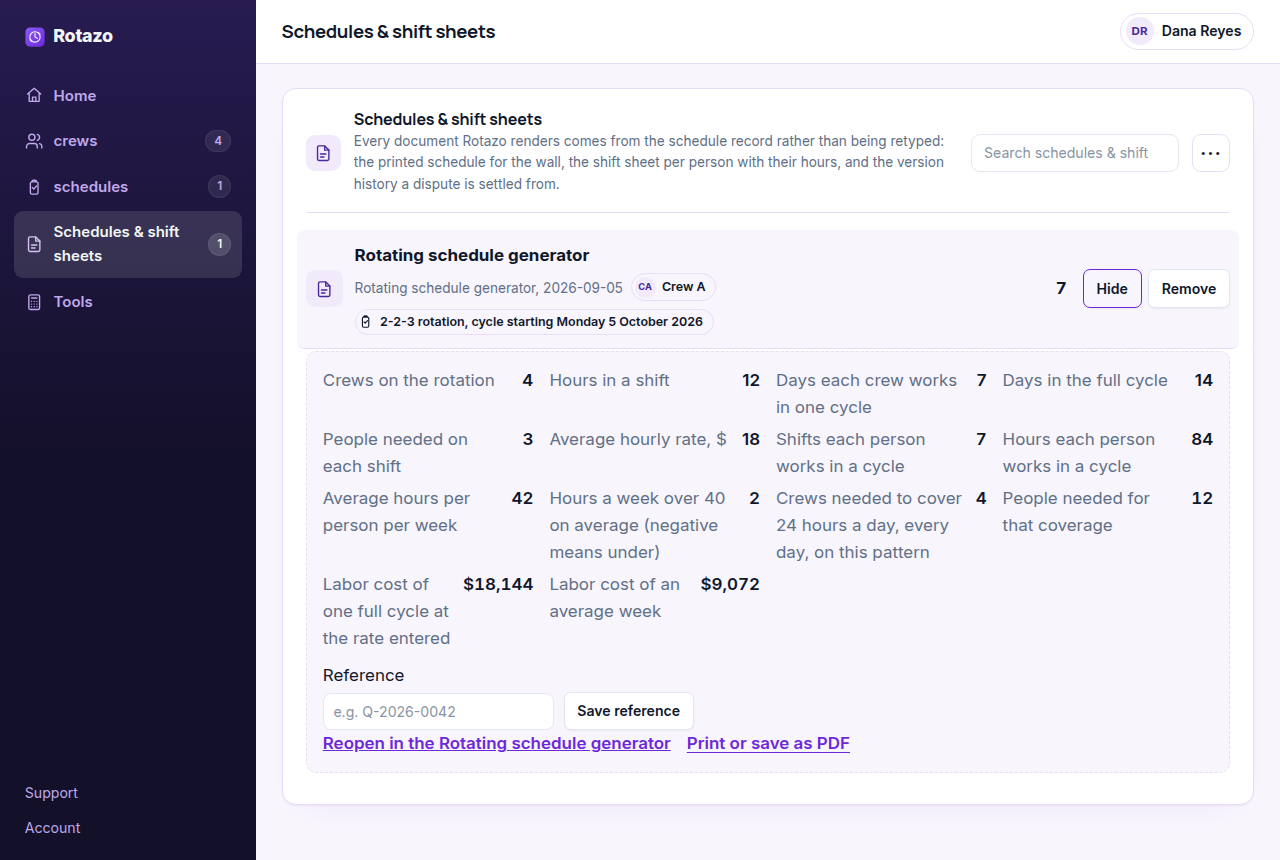
The rotating schedule generator lays out a shift rotation from your own figures rather than a published template: how many crews rotate, how long a shift is, how many days a crew works before the pattern repeats and how long the whole cycle is, how many people each shift needs, and what an hour costs. It returns the average hours each person works a week and how far over forty that runs, the crews and the people it takes to cover twenty-four hours every day on that pattern, and the labor cost of a cycle and of an average week. A 2-2-3, a Pitman, a DuPont and a 4 on 4 off are all the same arithmetic with different days on and cycle lengths.
Why the worksheet asks for days on and cycle days, not the pattern's name
Every rotating schedule reduces to two numbers: how many days a crew works in a cycle and how long the cycle is. A 2-2-3 works seven days of fourteen; a 4 on 4 off works four of eight; a DuPont works fourteen of twenty-eight; a 9/80 works nine of fourteen. Those two numbers, with the shift length, give the average hours per person a week, which is the figure that decides whether a pattern is legal, affordable and bearable. Naming the pattern tells you the shape of the weekends; the two numbers tell you the hours, and the hours are what the crew and the payroll actually experience.
Coverage is a division, and it is where most patterns break
To cover twenty-four hours every day, the shifts in a day (twenty-four divided by the shift length) have to be multiplied by the share of days a crew is off, which is the cycle divided by the days on. On 12-hour shifts with a crew working half its days, that is two shifts times two, four crews. A manager who runs the 2-2-3 with three crews because the fourth was never hired is not running a 2-2-3; they are running everyone at 56 hours a week and calling it the pattern. The crews and people figures on this worksheet are the honest headcount the pattern needs, before overtime and before anyone is sick.
What the average hours mean for overtime
Federal overtime under the Fair Labor Standards Act is owed on hours over forty in a workweek, week by week, not averaged across the cycle. A 2-2-3 on 12-hour shifts averages 42 hours but alternates 36-hour and 48-hour weeks, so the overtime is eight hours every other week rather than two hours every week. The worksheet shows the average and the amount over forty so the shape is visible; the week-by-week overtime depends on where the workweek is set, and the cited federal rules are the place that decision starts. Nothing here is a ruling on your own crew's pay.
Where the constants in this tool come from
29 CFR Part 778, Overtime Compensation, the federal regulations on the workweek and hours over forty under the Fair Labor Standards Act. Why the worksheet shows hours over forty as a weekly figure and does not average them across the cycle: the federal overtime rules count each workweek on its own, so a rotation that averages 42 hours is a 36-hour week and a 48-hour week in turn.
What a shift manager asks before running the Rotating schedule generator
Which figures do I need before using the rotating schedule generator?
How many crews rotate, how many hours a shift is, how many days a crew works in one cycle and how many days the cycle is, how many people a shift needs, and an average hourly rate. If you know the pattern's name, the guide pages give its days on and cycle length.
Why does it give crews needed as well as crews entered?
Because they are often different. Crews entered is what you have; crews needed is what the pattern takes to cover the clock. When the second is larger, the gap is being covered by overtime or by nobody, and both show up eventually.
Does the worksheet calculate overtime pay?
No. It shows average hours and the amount over forty so the pattern's shape is visible. Overtime is owed week by week under federal law and some states add daily rules, so the pay calculation depends on where your workweek starts and which state you are in.
Rotazo Pro
Keeping the schedule everyone actually saw
Upgrading turns the worksheet into the record. The pattern becomes a schedule with names on it; every publish is a dated version; a swap or a call-out is recorded against the shift with who covered it; every person's hours add up on their own page. Export is always available, so the schedule history is yours whether or not you stay.
- Download the schedule as a file to send to the crew
- Your schedule and shift sheets without our name on them
- Save a pattern and open it again next cycle
- Your business name and logo on every printed schedule
- Take every schedule and shift sheet out at once
- Send the published schedule or a shift change to the crew from inside the record
$7per month, whole team
Start Rotazo Pro PricingRotazo Pro is $6.50 per month for your whole team, billed monthly, and renews each month at that price until you cancel. The price and the renewal terms are shown again before checkout.